





Oil spills pose serious environmental risks. Containing these spills quickly and effectively is crucial. This article will explore some popular methods of oil containment, including the use of polyurea containment applications.
Booms and Skimmers
Booms are barriers that float on the water’s surface. They contain oil spills, preventing the spread of oil. Booms have skirts that hang below the water, trapping oil. Workers place booms around the spill to contain the oil in one area. This makes it easier to remove the oil from the water.
Skimmers are devices that remove oil from the water’s surface. They work in conjunction with booms. Skimmers collect the contained oil, separating it from the water. Different types of skimmers are used, depending on the spill’s location and size. For example, some skimmers are designed for use in calm waters, while others work better in rough conditions.
Sorbents
Sorbents are materials that absorb or adsorb liquids. In oil spills, sorbents soak up the oil from the water. There are three types of sorbents: natural organic, natural inorganic, and synthetic. Each type has its own advantages and applications.
Natural organic sorbents include materials like peat moss and straw. These materials are biodegradable and environmentally friendly. However, they can become heavy when saturated with oil.
Natural inorganic sorbents include materials like clay and vermiculite. These materials are often used in smaller spills or for final cleanup stages. They are less effective in large-scale spills but are useful for spot cleaning.
Synthetic sorbents are made from man-made materials like polypropylene. They are lightweight and can absorb large amounts of oil. Because of their high efficiency, they are often used in large spills.
Polyurea Containment Applications
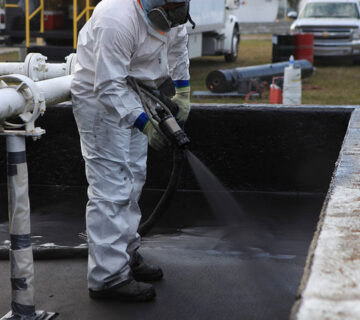
Polyurea is a type of polymer used in various containment applications. It is known for its durability and resistance to chemicals. In oil containment, polyurea coatings create a barrier that prevents oil from penetrating surfaces.
Workers apply polyurea coatings to various surfaces, such as concrete or metal, to create a seamless, waterproof barrier. This barrier helps contain oil spills, preventing them from spreading. Polyurea coatings are also used in secondary containment systems. These systems provide an additional layer of protection, ensuring that oil does not escape into the environment.
Polyurea’s fast-curing properties make it ideal for emergency situations. It can be applied quickly, forming a strong barrier in a short amount of time. This rapid application helps minimize the impact of oil spills, protecting the environment more effectively.
Learn more about oil spill containment here
Temporary Storage Tanks
Temporary storage tanks are used to store recovered oil during spill response operations. These tanks are portable and can be quickly deployed to the spill site. They provide a safe and efficient way to store large volumes of oil until it can be properly disposed of or processed.
There are different types of temporary storage tanks, including flexible bladders and rigid tanks. Flexible bladders are made from durable materials that can withstand harsh conditions. They are lightweight and easy to transport, making them ideal for use in remote locations. Rigid tanks are more robust and can store larger volumes of oil. They are often used in industrial settings where large spills are more common.
In-Situ Burning
In-situ burning is a method of oil containment that involves igniting the oil on the water’s surface. This method is used when mechanical recovery methods are not feasible. In-situ burning reduces the oil volume, minimizing its environmental impact.
To conduct in-situ burning, responders use fire-resistant booms to contain the oil. Once the oil is contained, they ignite it, causing it to burn off. This method can remove up to 95% of the oil, making it an effective containment strategy. However, it is not always suitable, as it requires specific conditions and can produce harmful emissions.
Bioremediation
Bioremediation uses microorganisms to break down oil into less harmful substances. This method is environmentally friendly and can be used in conjunction with other containment methods. Bioremediation can occur naturally or be enhanced by adding nutrients and oxygen to the spill site.
Natural bioremediation relies on existing microorganisms in the environment to degrade the oil. Depending on the type and amount of oil, this process can take a long time.
Enhanced bioremediation involves adding specific microorganisms or nutrients to speed up the process. This method is more controlled and can be tailored to the specific conditions of the spill site.
Conclusion
Oil containment is a critical aspect of spill response. Methods like booms and skimmers, sorbents, polyurea containment applications, temporary storage tanks, in-situ burning, and bioremediation each have their own advantages. Understanding these methods and their applications helps us respond to oil spills more effectively, protecting our environment and minimizing damage.
4o